Conclusion
Writesonic presents itself as a comprehensive SEO content platform with a robust set of features tailored for content marketers and agencies. Its Article Writer and Chatsonic AI Agent are particularly noteworthy, offering a high degree of customization and functionality. However, the platform’s complexity and pricing may be prohibitive for casual users or those on a tight budget. While the output quality is decent, it still requires significant editing, making it more of a drafting tool than a complete solution.
Pros
- Offers a high level of control and customization in article generation
- Comprehensive SEO tools suite integrated into the platform
- Chatsonic AI Agent provides useful multi-step research capabilities
- Stable performance with no crashes or lag issues
- Forward-looking AI Search Visibility (GEO) feature
Cons
- High pricing may be excessive for solo writers or casual bloggers
- Complex dashboard can be overwhelming for beginners
- Several key features are still in beta or gated behind higher tiers
- Output requires significant editing and is not ready for publication without human input
Table of Contents
- Introduction
- First Impressions and Dashboard Experience
- Core Features
- Performance and Output Reliability
- Pricing Breakdown and Limitations
- Privacy and Data Handling
- Writesonic vs Contentpen vs Nextblog
- Final Verdict and Overall Score
- Frequently Asked Questions
Introduction
I’ll be honest, when I first signed up for Writesonic, I expected another AI article generator dressed up with some SEO labels and a dashboard that looks impressive until you actually start using it. What I found was something more layered than that, and also more complicated than it needs to be.
Writesonic has clearly moved away from positioning itself as just a writing tool. It now wants to be a full SEO and content operations platform, one that covers everything from article generation to AI search visibility tracking. That’s an ambitious play, and in some areas it genuinely delivers. In others, it overcomplicates things for no good reason.
Writesonic suits content marketers, SEO-focused bloggers, agency teams managing multiple clients, and anyone running a content operation at scale who wants keyword research, long-form article generation, and GEO tracking all in one place. It does not suit casual writers, solo creators on a tight budget, or anyone who just wants to open a tool and start writing without going through 10 steps first. If simplicity is what someone is after, this will feel like overkill within the first 15 minutes.
First Impressions and Dashboard Experience
The onboarding asks for a website URL right away and then offers two main paths: AI Search Tracking (GEO) or SEO and Content Optimization. That immediately tells you the kind of tool it aims to be. It’s not here for personal blogs or casual writing projects. It’s built around the assumption that there is a live website, a content strategy, and a reason to care about rankings.


My first reaction was genuinely mixed. The layout looks polished and the categories make logical sense, but there are so many entry points that it takes a few minutes just to figure out where to start. For someone who has used other AI writing tools before, it’s manageable. For a first-time user with no context, I think it could be overwhelming pretty fast. The home screen also surfaces a GEO widget pushing the “Analyze my website” button front and center, which felt more like a product upsell than a helpful starting point.
Core Features
Article Writer
This is the main event. Article Writer is a 10-step long-form article generator, and I tested it properly by running through the full flow for a Writesonic review article.

The workflow is as follows:
- Input a topic
- Choose an article type (Product Reviews, Blog Posts, How-to Guides, Listicles, Comparison Articles, Technical Pieces, Glossary Pages)
- Select research method: AI Web Research (recommended, sourcing from hundreds of sites) or Custom Sources (upload your own files or URLs)
- Pick up to 5 competitor or reference articles from top-ranking results, or add your own URL
- Select a primary keyword from recommended options, including volume, difficulty, and intent data
- Choose a title from AI suggestions or craft your own
- Select up to 20 secondary keywords
- Set up article structure: word count (500 to 5000 words), writing style based on your brand voice, perspective, and an expert guidance box for custom instructions
- Choose or customize an outline with H2 and H3 headings
- Add extra features: humanized article (beta), expert quotes, images, internal and external links, cover image, CTA, key takeaways, FAQs


The level of control here is genuinely impressive. I could set the point of view to first person, add expert guidance on where to place each section and control how many paragraphs I wanted under each of them, pick “Product Reviews” as the article type, train it on my existing writing style by uploading a DOCX sample, and customize the outline completely. That’s more configuration than most tools in this space offer.
The article it generated was structured, covered the topic with decent depth, and had proper SEO formatting throughout. It wasn’t perfect out of the box though. The opening paragraphs had that slightly generic “AI warm-up” quality where it eases into the topic without really saying anything interesting for the first few sentences. The body sections were stronger. Subheadings made sense, the information was organized logically, and it didn’t repeat itself excessively.
The humanized article feature remains in beta, and it’s evident. The version that appears slightly more casual doesn’t convincingly mimic natural speech. I still needed to revise quite a bit to make it sound genuinely human and opinionated.
The 10-step flow takes around 5 minutes from start to article. Writesonic also offers an Instant Article (beta) option that takes about 1 minute, where you just provide a topic, article type, and optional keywords and it handles the rest. For quick drafts it works, but the output quality is noticeably lower than the full 10-step process.
Chatsonic with AI Agent Mode
Chatsonic is Writesonic’s chat interface and it comes with an AI Agent toggle that can run multi-step research tasks autonomously. I tested this by asking it to analyze a blog and identify SEO issues and fixes.


The results were surprisingly comprehensive. After about 31 seconds of processing, it performed multiple tasks: analyzing organic keyword rankings, identifying leading competitors in the US, reviewing backlink profiles, assessing traffic distribution, conducting a technical SEO audit, and comparing keyword strategies. The output featured a structured findings panel with prioritized actions over 8 weeks, secondary keyword suggestions, content gap analysis, and a pillar-cluster content framework.

That’s a solid output for a chat prompt. The findings were specific enough to be actionable, not just generic SEO advice. The competitor keyword suggestions it gave me were relevant and the content hub structure idea was practical.
The downside is the message limit. On the trial, I had 2 SEO & Content AI Agent messages left from the start, which means the free access to this particular feature is extremely limited. If this is the feature someone is most interested in, they’ll hit the wall fast.
Chatsonic includes a Prompt Templates section with categories such as SEO, Analytics, Competitor Analysis, Content Strategy, and Content Creation.

These templates operate within the same Chatsonic interface and serve as genuinely helpful starting points.
SEO Tools Suite
The SEO Tools menu offers three research tools and three optimization tools. Research includes AI Topic Clustering (first two generations free), Keyword Research, and Answer The People. Optimization features Content Gap Analysis (first five generations free), SEO Checker and Optimizer, and an upcoming Automated Internal Linking.

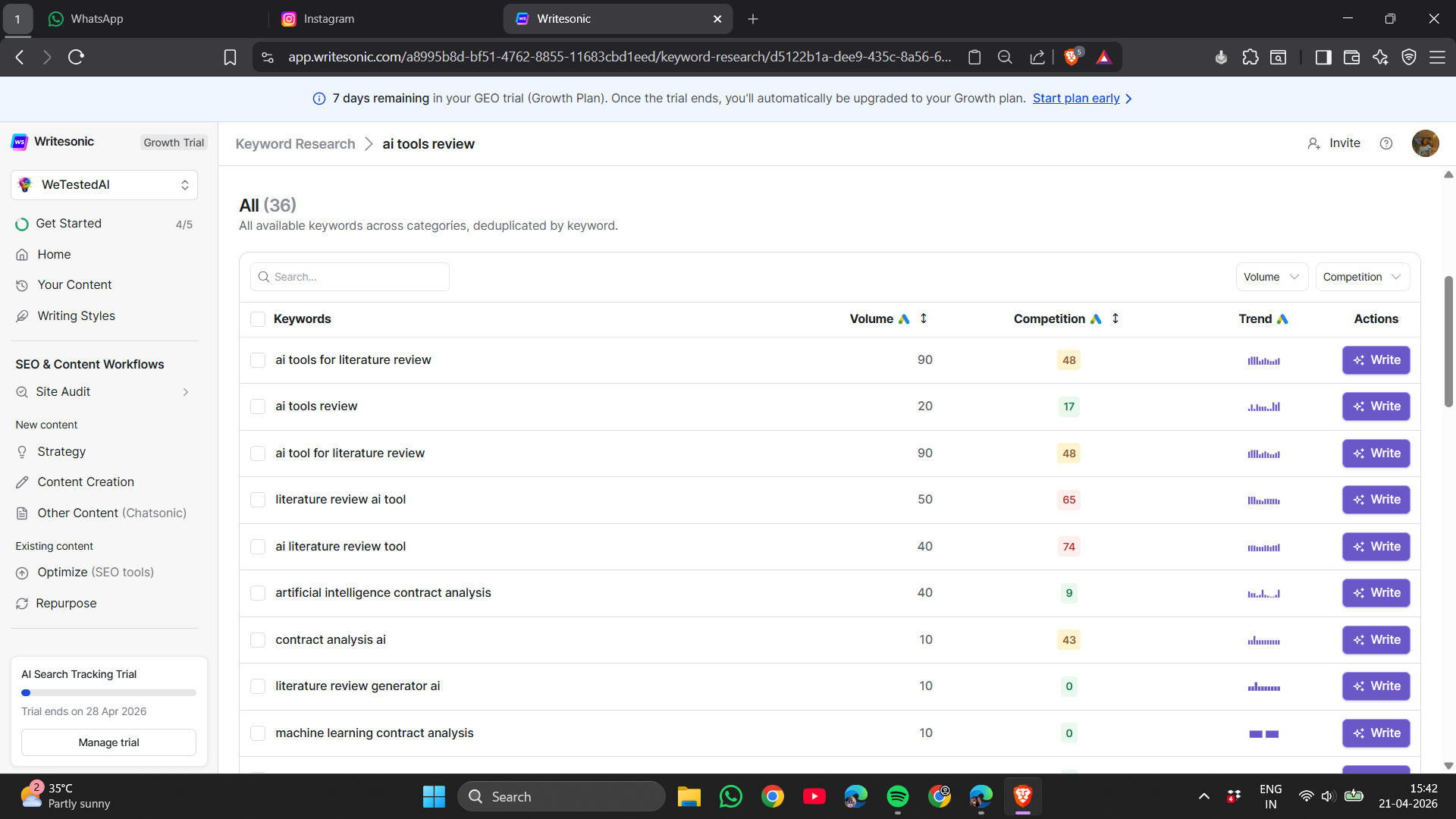
I used the Keyword Research tool with “ai tools review” as the seed keyword. It returned 36 deduplicated keywords across categories, showing volume, competition score, trend graph, and a Write button to directly kick off article generation from any keyword. The data itself was reasonable, the competition scores were clearly color coded (green for low, amber for medium, red for high), and the trend graphs gave a quick visual sense of whether a keyword was rising or flattening. It’s not as deep as a dedicated SEO tool like Ahrefs or Semrush, but it’s functional and genuinely useful for content planning without leaving the platform.

The Site Audit tool performed a comprehensive review of WeTestedAI.com, resulting in a health score of 50/100. The report categorized issues into Content, Indexing, Security, Pagespeed, Technical SEO, Not Indexed, Response Codes, Canonical, and Social issues. It analyzed 68 of 69 pages, displaying domain authority, organic traffic, backlinks, and referring domains at a glance. Although in beta and taking a few minutes, the report was well-structured and highlighted areas needing attention.
AI Search Visibility (GEO)
This is Writesonic’s newest and most marketed feature. The GEO section tracks how visible a brand is across AI platforms like ChatGPT, Gemini, and Perplexity. It includes an Overview, AI Bot Analytics, Citations, Sentiment, Prompts, and an Action Center.


The AI Bot Analytics page specifically monitors which AI crawlers visit your site, which pages they access, their frequency, and trend patterns over time. This addresses a blind spot in traditional analytics tools like Google Analytics, which do not track AI crawler traffic.
The concept is indeed forward-looking. As AI assistants increasingly replace traditional search for research, understanding how AI platforms perceive a brand is becoming crucial. The Action Center translates visibility gaps into actionable recommendations, offering more value than a mere dashboard of metrics.
That said, this feature is still maturing. The GEO trial is a completely separate tier from the main content tools trial, which means it requires its own plan selection. The data it surfaces is interesting but limited in depth right now. For an early-stage blogger or small site, the GEO score numbers won’t mean much yet. For agencies managing established brands, I can see this becoming genuinely valuable as AI search continues to grow.
Brand Voice and Writing Style
The writing style feature lets me train Writesonic on my existing content by adding URLs for it to scan, uploading PDF or DOCX files, or pasting text snippets. I uploaded a DOCX of an existing review and it generated a brand voice summary describing the style as “conversational, relatable, and analytical, blending personal experiences with balanced assessments and a focus on practical utility.”


When I used this style in Article Writer 6, the output was slightly more grounded in tone compared to a generic generation. It wasn’t a dramatic transformation but there was a noticeable difference in sentence length and the tendency to include more evaluative language. The feature works better as a directional guide than as a true voice replication. It moves the output in the right direction but doesn’t remove the need for editing entirely.
Performance and Output Reliability
Throughout testing, the platform remained stable—no crashes, failures, or lag issues. The 10-step article creation process consistently took around 5 minutes, with a progress indicator displaying each stage: real-time data collection, web research, fact verification, word count management, competitor analysis, quote extraction, and brand voice adjustment.
On output quality, the base articles were solid but not spectacular. They were well-structured, SEO-friendly, and covered the topic properly. The first-person POV setting worked and the articles didn’t have that detached third-person AI narrator tone that a lot of tools default to. However, the opening and closing sections consistently needed the most editing. The introductions especially had a tendency to ease in too gently, spending two or three sentences orienting the reader before saying anything of substance.
The humanized article beta feature is worth testing but I wouldn’t rely on it as a final step. It changes the surface-level phrasing but doesn’t fundamentally shift the personality of the writing.
Pricing Breakdown and Limitations
Writesonic runs four main plans billed annually: Starter at $79 per month, Basic at $199 per month, Growth at $399 per month, and Enterprise at custom pricing. These are not cheap, and the jump between Starter and Basic is steep.


The AI Search Visibility (GEO) feature is a completely separate trial and paid tier. Its own plans run at approximately $79 per month (Starter), $199 per month (Basic), and $399 per month (Growth) as annual rates, billed in INR in some regions. The Starter GEO tier includes AI analytics, 50 prompts daily across ChatGPT, 1 region and 1 language with daily tracking frequency, and SEO content tools with 15 AI articles per month.
On the 7-day trial with Growth plan access, the key limitations I hit were:
- Only 2 SEO & Content AI Agent messages available in Chatsonic
- GEO features are on a separate trial timer entirely
- AI Topic Clustering and Content Gap Analysis have limited free generations
- The full writing style, advanced configurations, and enhancement features require a paid plan to use consistently at scale
Regarding pricing, $79/month is reasonable if you frequently use Article Writer 6 and require the keyword research and site audit features. The higher tiers at $199 or $399 make sense mainly for agencies or teams producing large volumes of content. For individual bloggers publishing only a few articles monthly, the cost may be difficult to justify against simpler, lighter tools.
Privacy and Data Handling
Writesonic gathers account details, usage metrics—including generated content and interactions—and device information. Payment is processed through third-party services. Content uploaded for training (PDFs, DOCX, URLs) is used to enhance personalization. According to their policy, data is not sold to third parties. Security features include encryption and access controls. Users can access, modify, or delete their data as needed. While there’s nothing overtly concerning, it’s important to remember this isn’t a zero-data platform; sensitive brand information should be uploaded with caution.
Writesonic vs Contentpen vs Nextblog
|
Feature |
Writesonic |
Contentpen |
Nextblog |
|
Starting Price |
$79/mo (annual) |
$39/mo |
$29/mo |
|
Article Length |
Up to 5,000 words |
~4,000 words |
~3,000+ words |
|
Quality of output |
Moderate-good |
Good |
Moderate |
|
Max Articles per month (for entry level plan) |
5 articles/month |
10 articles/month |
30 articles/month |
|
SEO Tools |
Keyword research, site audit, topic clustering, content gap |
Keyword dashboard, SEO score, internal linking tracker |
Basic SEO structure |
|
GEO / AI Visibility |
Yes, dedicated feature set |
No |
No |
|
Writing Style Training |
Yes, via URL/file/text |
No |
No |
|
Built-in AI Editor |
Chatsonic with AI Agent |
AI chat inside editor |
No AI chat, manual editing only |
|
Automation |
Partial, content creation focused |
Scheduling and publishing |
Strong auto-generate and auto-publish |
|
Article Images |
AI generated cover image, optional inline images |
Multiple images inserted throughout |
One cover image at top |
|
Integrations |
WordPress, and others |
WordPress, Ghost, Webflow, Shopify |
WordPress, Webflow, Shopify, Wix, Notion, Ghost, API |
|
Free Plan / Trial |
7-day trial only |
Trial with 3 articles/month |
14-day trial on paid plans |
While all three tools focus on SEO content, they cater to different user needs. Nextblog is the most automated, handling setup, execution, and publishing automatically, with pricing aligned to its entry-level production focus. Contentpen offers a middle ground, providing more customization, higher-quality writing, SEO scoring, and a structured content workflow at a mid-tier price. Writesonic is the most comprehensive, encompassing article creation, keyword research, site audits, SEO analysis through Chatsonic, and GEO tracking—though at a notably higher cost.
If I had to pick one personally, I’d lean toward Contentpen for the balance it strikes between control, output quality, and price. Writesonic does more, no question, but a lot of what it does is either in beta, gated behind higher tiers, or covered well enough by standalone tools I already use. For someone who wants an all-in-one platform and is willing to pay for it, Writesonic makes sense. For someone who primarily needs quality long-form SEO articles with good customization, Contentpen gives more value per dollar. Nextblog wins purely on automation and volume, but the writing quality and editing experience lag behind both.
Final Verdict and Overall Score
Writesonic is a genuinely capable platform that has grown well beyond its original positioning as an AI writing assistant. The Article Writer 6 workflow is one of the more thorough article generation processes I’ve tested. The SEO tools suite is functional and well-integrated. The Chatsonic AI Agent is impressive when it runs, even if the trial limits make it hard to evaluate deeply. The GEO/AI visibility tracking is a smart bet on where content marketing is heading, even if the feature isn’t fully mature yet.
Its main drawbacks are the cost relative to smaller users, a complex dashboard that may overwhelm beginners, and the fact that several key features (humanized articles, automated internal linking, advanced GEO insights) remain in beta or are only available at higher tiers. The output from Article Writer 6 is decent but not ready for publication without editing, so it primarily accelerates drafting rather than replacing human input.
For agencies, large content teams, and SEO-focused creators producing at scale, Writesonic offers a robust platform worth the investment. Conversely, solo writers or casual bloggers may find the pricing and complexity somewhat excessive for their needs.
Overall Score: 7.8 out of 10
Frequently Asked Questions
Writesonic is an SEO content platform that offers article generation, keyword research, and AI search visibility tracking. It is best suited for content marketers, SEO-focused bloggers, and agency teams managing multiple clients. It is not ideal for casual writers or those on a tight budget due to its complexity and pricing.
Writesonic’s Article Writer is a 10-step process that includes inputting a topic, selecting an article type, choosing research methods, picking competitor articles, selecting keywords, and customizing the article structure. It offers a high level of control and generates well-structured, SEO-friendly articles, although some editing is still required.
Writesonic offers several key features including Article Writer for long-form content, Chatsonic with AI Agent Mode for multi-step research tasks, SEO tools for keyword research and site audits, and AI Search Visibility (GEO) for tracking brand visibility across AI platforms. It also includes brand voice training and writing style customization.
Writesonic’s pricing starts at $79 per month for the Starter plan and goes up to $399 per month for the Growth plan, with custom pricing for Enterprise. While it offers a comprehensive suite of tools, the cost may be justified for agencies or large content teams, but it might be excessive for solo writers or casual bloggers.
The main drawbacks of Writesonic include its high cost relative to smaller users, a complex dashboard that may overwhelm beginners, and several key features that are still in beta or only available at higher pricing tiers. Additionally, the output from Article Writer requires editing and is not ready for publication without human input.
Writesonic is more comprehensive than both Contentpen and Nextblog, offering a wider range of features including AI search visibility tracking and advanced SEO tools. However, Contentpen strikes a better balance between control, output quality, and price, while Nextblog excels in automation and volume but lags in writing quality and editing experience.
Writesonic receives an overall score of 7.8 out of 10. It is a capable platform with a thorough article generation process and well-integrated SEO tools. However, its complexity and pricing may be excessive for smaller users, making it more suitable for agencies and large content teams producing at scale.
Abonneer je op onze nieuwsbrief en ben als eerste op de hoogte van tijd- en geldbesparende AI-tools!
Comments